
Truer Valentine
Things of the Heart

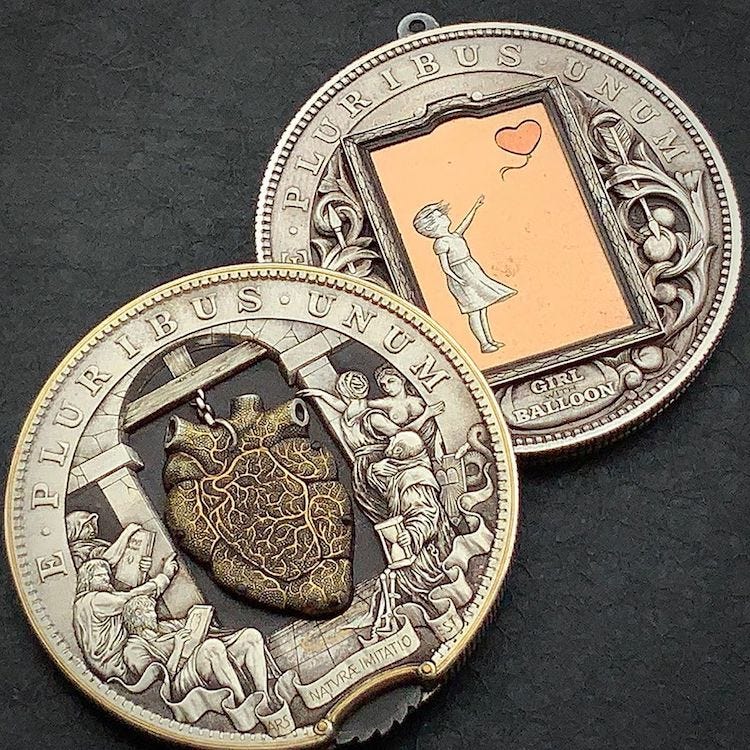
Origin of Valentine
Around 270 AD, in the heart of the Roman Empire, lived a bishop named Saint Valentinus of Terni, Italy. He was a physician, a patron of epileptic patients and beekeepers, and a man of deep faith and kindness. At a time of war and hardship, he stood as a beacon of hope, tending to the sick and weary.
During this period, Emperor Claudius II Gothicus observed that unmarried soldiers fought more fiercely than those with families. As a result, he issued a decree banning marriages to ensure more men were recruited into the military. Young men, desperate to escape conscription, sought secret marriages. Saint Valentinus defied the emperor’s orders, secretly performing marriages for lovers who wished to honour their union before God. His defiance was not just an act of romance but an act of resistance—upholding faith, love, and the sanctity of marriage.
Valentinus’ defiance led to his arrest. He was brought before Emperor Claudius II, who initially admired his wisdom. However, when Valentinus attempted to convert the emperor to Christianity, he was sentenced to death and placed under the custody of an aristocrat named Asterius. Asterius made the mistake of allowing the preacher to speak. Father Valentinus spoke passionately about Christ. Asterius made a bargain with Valentinus: If the Christian could cure Asterius’s foster daughter of blindness, he would convert. Valentinus placed his hands over the girl’s eyes and prayed:
“Lord Jesus Christ, enlighten your handmaid because you are God, the True Light.”
The child was miraculously healed. Asterius and his entire household were baptized. When the emperor learned of this, he ordered them all to be executed but Valentinus' was beheaded. He was beheaded on February 14, 269 AD, becoming a martyr for his faith.
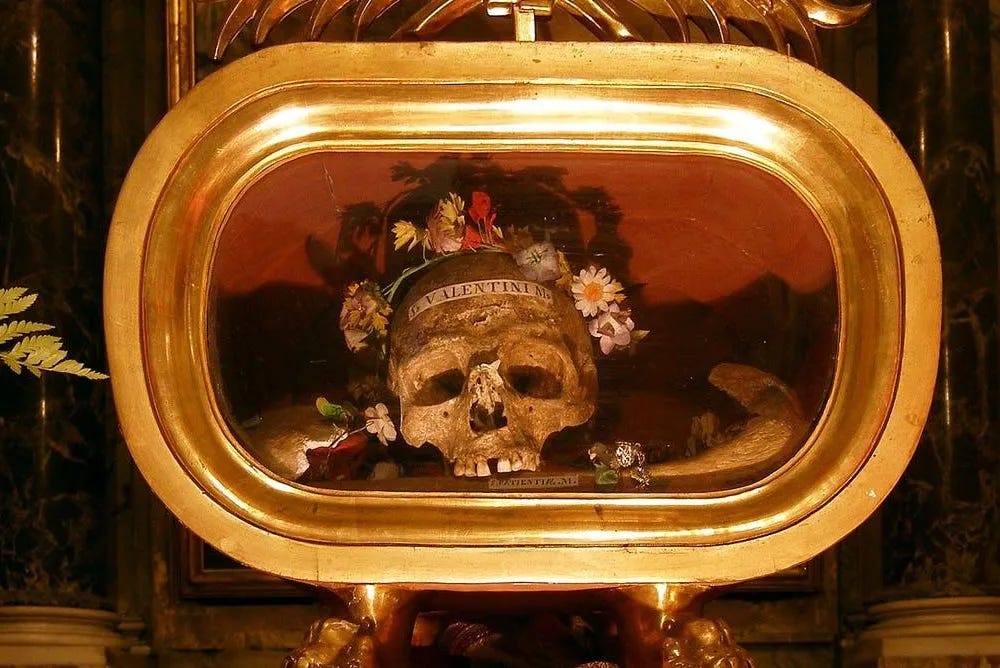
However, only Valentinus. A pious widow retrieved his body and buried it along the Via Flaminia (the ancient highway stretching from Rome to present-day Rimini). Later, a chapel was built over his grave in his honour. His skull, adorned with flowers, remains on display today as a symbol of his sacrifice.
The Evolution of Valentine’s Day
The romantic associations with Valentine's Day didn’t emerge until the Middle Ages. Geoffrey Chaucer played a significant role in this through his poem Parliament of Foules (circa 1375), which linked Valentine's Day with romantic love. The poem connected the feast day with the medieval belief that birds began their mating season on February 14.
The oldest known romantic valentine is a poem written by Charles, Duke of Orléans, to his wife in 1415 while he was imprisoned in the Tower of London. By the 1600s, the exchange of valentine messages had become common in England. The tradition of sending cards and gifts gained widespread popularity in the 1850s, particularly in the United States, when Esther A. Howland began mass-producing sentimentality through valentine cards.
Today, Valentine’s Day is widely celebrated, but its original essence has faded into a sea of roses, chocolates, and grand gestures. Different cultures interpret the day in unique ways. In Japan, women give chocolates first, while men reciprocate a month later. In Finland, it is not a lovers’ holiday but Ystävänpäivä—Friendship Day. These variations remind us that love is not confined to romance alone; it is a universal force that transcends relationships, cultures, and eras.
Truer Love
But in chasing roses, chocolates, and fleeting sexual passions, we have forgotten the essence of this day. Valentine's Day was never about extravagant gestures—it was about agape love, obedience to God, and the courage to stand for something greater than oneself.
A truer Valentine isn’t about loving only when it is beneficial or looks good; it is about following God’s command of love:
"You shall love the Lord your God with all your heart and with all your soul and with all your might. This is the greatest and first commandment." – Matthew 22:37-38
"And the second is like it: You shall love your neighbour as you love yourself." – Matthew 22:39
"But I say to you, love your enemies and pray for those who persecute you." – Matthew 5:44
Truer Valentine is also seen in parents who toil selflessly for their children, in spouses who brave life's storms together, and in friends who remain steadfast through adversity and distance—these are the true embodiments of Valentine’s spirit.
Perhaps the greatest love story is not the one written in sonnets but the one etched in sacrifice. True love is not measured in gifts but in the willingness to give of oneself. Just as Saint Valentinus gave his life in service of others and Jesus Christ gave His life to save us all, love is ultimately about sacrifice. To honour St. Valentinus is to honour love in its purest form—godly, steadfast, fearless, and obedient.
So, this Valentine’s Day, let us celebrate not just with gifts but with acts of love that leave a lasting mark. Who in your life needs to feel truly seen and loved today?
Note: The story of St. Valentine became widely known thanks to the Bollandists, a group of Belgian monks named after Jesuit scholar Jean Bolland. Beginning in 1643, they spent three centuries compiling Acta Sanctorum—a 68-volume collection of saints' lives—until the final volume was published in 1940. (Source: Smithsonian Magazine)
We have a chat going on about building discernment for the year, check out Things of Habit: Say…Discernment and do join us👇🏽

Beautiful